Poisonous to eat
Never eat a wild plant unless you are 100% certain what it is. Don't touch or eat any plant you don't know, and wash your hands after working in the garden or walking in the woods.
Identify
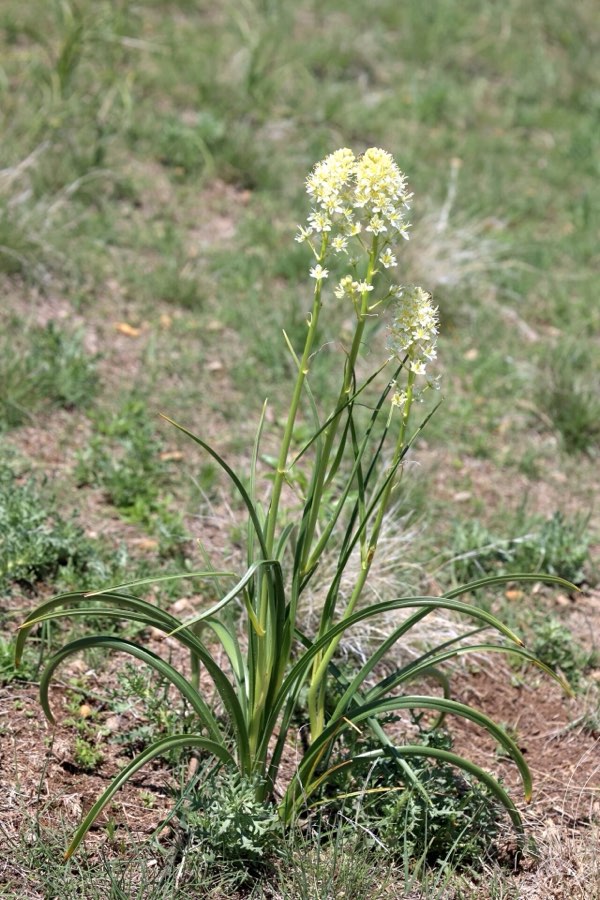
- Bulb. Onion-like, 1 to 1.5 inches, with blackish outer scales, buried 4 to 6 inches deep.
- Leaves. Grass-like and V-shaped (folded), growing from the base.
- Flowers. Pointed clusters of small greenish-white to yellowish-white six-petaled flowers on a central stalk 6 to 18 inches tall.
- When. One of the first plants up in spring. Flowers April to July, depending on elevation.
- Where. Meadows, pastures, grassy hillsides, stream banks, open forests and roadsides.
Why it's dangerous
- Every part, always. Bulbs, leaves, stems, flowers and seeds are poisonous. Seeds are the most toxic, then bulbs.
- Mistaken for food. The bulbs get mistaken for wild onion and for blue camas bulbs.
Lookalikes
- Wild onion. Wild onion has a strong onion smell. Death camas has no onion smell in any part. If unsure, don't eat it.
- Blue camas. Death camas bulbs are mistaken for blue camas (Camassia) bulbs, which grow in the same meadows.
What to do
- Call Poison Control right away. Don't make the person throw up unless Poison Control tells you to.
- Symptoms in 1 to 8 hours. Drooling, mouth numbness, headache, dizziness, nausea, repeated vomiting, diarrhea, weakness, confusion, low blood pressure, irregular heartbeat, trouble breathing, seizures and coma.
POISON CONTROL1-800-222-1222
Free, 24 hours, anywhere in the US. If someone collapses, has a seizure, has trouble breathing or can't be woken up, call 911 now.
SOURCES
WSU, Oregon State and University of Idaho Extension PNW104; University of Utah Poison Control; Montana State University Extension; Native Plant Trust. Checked Nov 17, 2026.
Doomkit is a reference, not a substitute for emergency services. In an emergency, call 911.