Can be deadly to eat
Never eat a wild plant unless you are 100% certain what it is. Don't touch or eat any plant you don't know, and wash your hands after working in the garden or walking in the woods.
Identify
- Leaves. Broad, triangular to kidney-shaped, with smooth edges or 5 to 7 shallow lobes, and no teeth. The leaf stalk attaches underneath the leaf, not at its edge.
- No tendrils. The slender stem twines around supports.
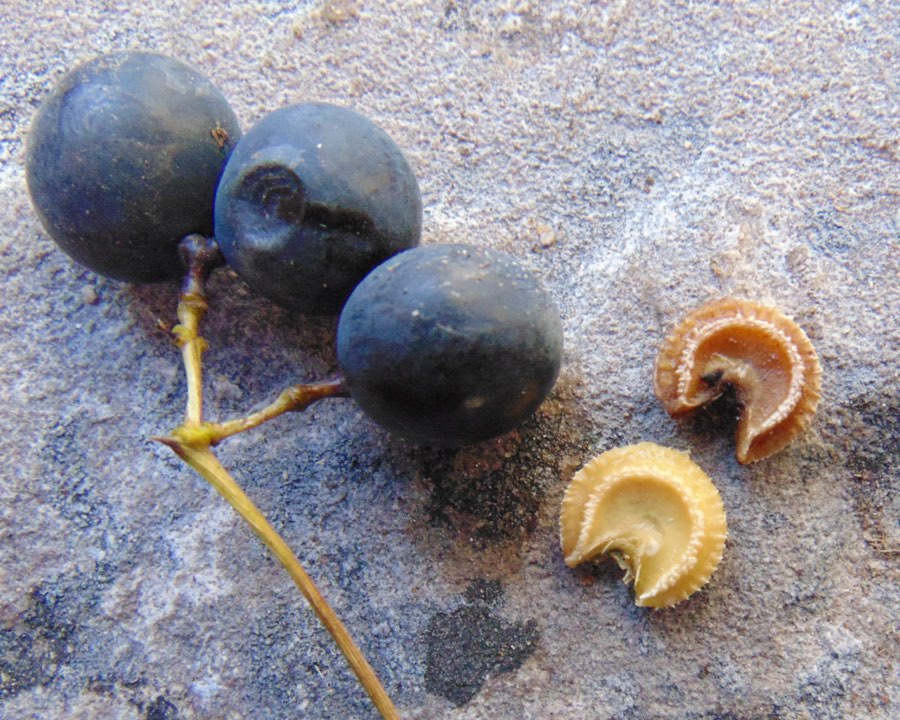
- Berries. Dark blue to black with a whitish coating, September to October.
- Seed. One flat, crescent-moon-shaped seed in each berry. That's where the name comes from.
- Where. Moist woods, bottomlands, ravines and bluffs.
Why it's dangerous
- Every part is toxic if eaten. The fruit contains alkaloids that cause seizures and can be fatal.
Moonseed or wild grape?
- Seeds. Grapes have 1 to 4 pear-shaped seeds. Moonseed has one crescent.
- Tendrils. Grapes climb with curling, often branched tendrils opposite the leaves. Moonseed has none.
- Leaves. Grape leaves have coarse teeth. Moonseed's don't.
- Bark. Grapevine bark usually shreds in long strips.
What to do
- Call Poison Control if anyone ate the berries or any part of the plant.
POISON CONTROL1-800-222-1222
Free, 24 hours, anywhere in the US. If someone collapses, has a seizure, has trouble breathing or can't be woken up, call 911 now.
Compare with
SOURCES
Missouri Department of Conservation; NC State Extension. Checked Nov 17, 2026.
Doomkit is a reference, not a substitute for emergency services. In an emergency, call 911.