Rash from touchingEvery part, even bare stems in winter. Never burn it.
Never eat a wild plant unless you are 100% certain what it is. Don't touch or eat any plant you don't know, and wash your hands after working in the garden or walking in the woods.
Identify
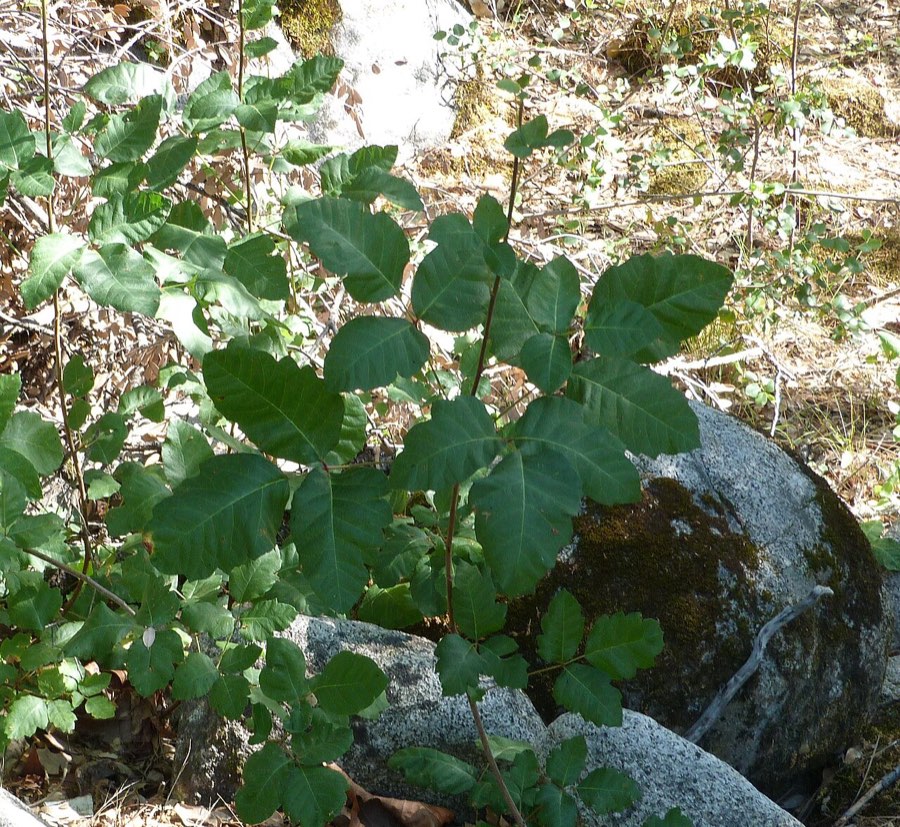
- Leaves of three. Usually three leaflets (Pacific poison oak sometimes has 5 or more). The middle leaflet sits on a longer stalk. Rounded, lobed edges that look like oak leaves.
- Pacific (West). A shrub 1 to 6 feet tall in sun, or a vine that climbs 75 feet or more into trees in shade. Glossy green in summer, red and orange in fall, bare in winter.
- Atlantic (East). A low, upright shrub up to about 3 feet, with leathery, fuzzy leaves crowded near the stem tips.
- Berries. Small whitish berries in clusters.
Why it's dangerous
- Same oil as poison ivy. It's in the stems, roots, leaves and berries. Bare winter stems still cause a rash.
- It lingers. The oil stays on tools, clothes and pets for months or years.
- Never burn it. Breathing the smoke causes severe breathing irritation.
Lookalikes
- Real oaks. Oak leaves grow one at a time, not in groups of three.
- Fragrant sumac and skunkbush. Their three leaflets meet at one point, with no stalk on the middle one, and their berries are red or hairy. Skunkbush doesn't cause a rash.
What to do
- Wash within 10 minutes if you can. That removes about half the oil; after 30 minutes most of it has soaked in. Use dish soap, or rubbing alcohol followed by cold water.
- The rash. Itching in 1 to 6 days, then blisters. Usually gone in 1 to 2 weeks. Blister fluid doesn't spread it.
- See a doctor for fever, pus, or a rash on the face, eyes, mouth or genitals.
- Call 911 for swelling of the face or throat, or trouble breathing.
POISON CONTROL1-800-222-1222
Free, 24 hours, anywhere in the US. If someone collapses, has a seizure, has trouble breathing or can't be woken up, call 911 now.
Compare with
SOURCES
UC IPM Pest Notes: Poison Oak; Oregon State University Extension PNW108; Alabama Cooperative Extension ANR-1460; NC State Extension; CDC NIOSH. Checked Nov 17, 2026.
Doomkit is a reference, not a substitute for emergency services. In an emergency, call 911.