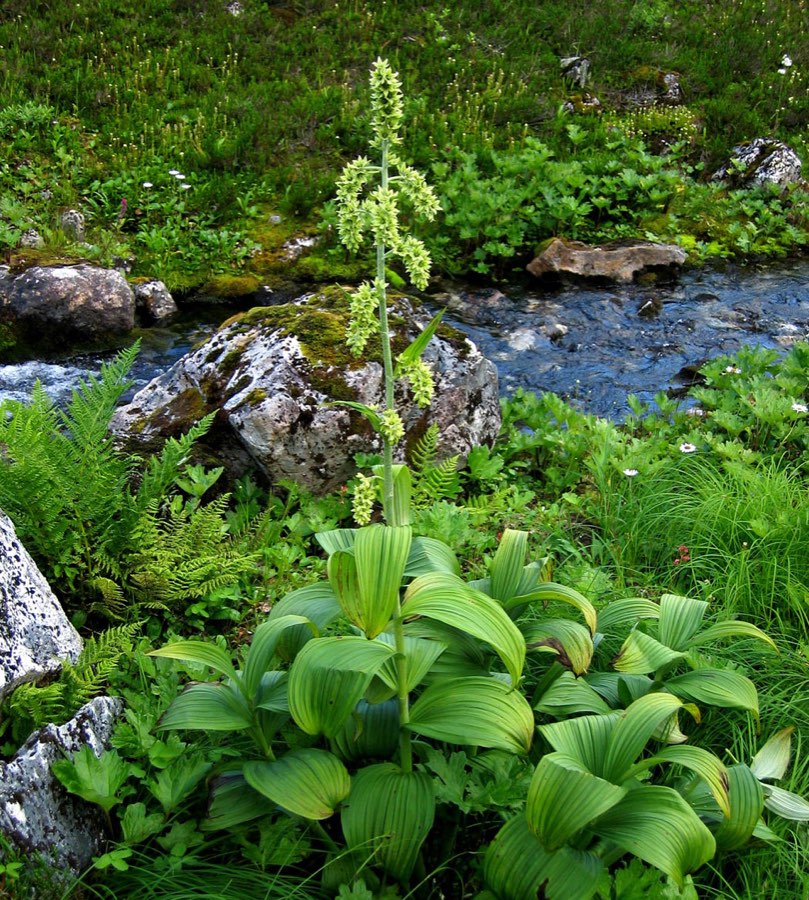
Poisonous to eatNot a skin hazard.
Never eat a wild plant unless you are 100% certain what it is. Don't touch or eat any plant you don't know, and wash your hands after working in the garden or walking in the woods.
Identify
- Leaves. Large, broad and pleated, with strong parallel ribs, 6 to 12 inches long and pointed. They clasp a stalk.
- Size. 2 to 8 feet tall, with a thick green stem.
- Flowers. Clusters of small star-shaped flowers in summer: yellow-green on the eastern species, cream-colored on the western one.
- Where. Swamps, wet woods, wet meadows and stream banks. The western species grows in mountain meadows and comes up as the snow melts.
Why it's dangerous
- Every part is poisonous to eat. The roots are the most poisonous. Touching it is not harmful.
- Symptoms in 30 minutes to 4 hours. Severe nausea and vomiting, then a slow heartbeat and low blood pressure, slow breathing, weakness, dizziness, numbness, sweating and drooling.
- Hospital care. Many people need heart medicines for hours or even days.
Lookalikes
- Ramps. Ramp leaves are flat, grow straight from the ground, and grow in rich upland forests. False hellebore leaves are pleated, grow from a stalk, and grow in floodplains, marshes and swamps.
- Smell isn't proof. Ramps smell like onion or garlic and false hellebore doesn't, but smell alone doesn't guarantee a plant is a ramp.
What to do
- Don't wait for symptoms. Call Poison Control right away. Most people who eat false hellebore need to go to the hospital.
POISON CONTROL1-800-222-1222
Free, 24 hours, anywhere in the US. If someone collapses, has a seizure, has trouble breathing or can't be woken up, call 911 now.
Compare with
SOURCES
Vermont Department of Health; Northern New England Poison Center; NC State Extension; USDA Agricultural Research Service. Checked Nov 17, 2026.
Doomkit is a reference, not a substitute for emergency services. In an emergency, call 911.